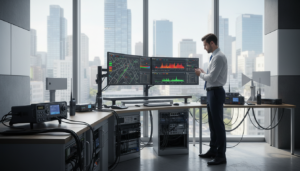
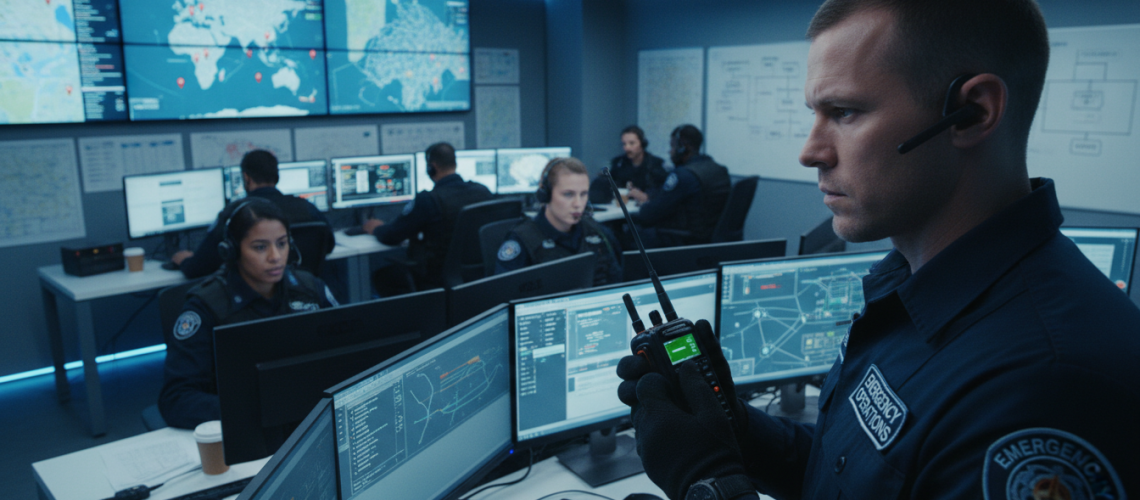
Did you know that signals intended for first responders can fall by more than 70% once they pass into modern buildings? That drop can turn a routine incident into a serious life-safety challenge.
We define an emergency responder radio communication system as the complete chain that moves a message from a handheld device through building antennas, a signal booster, an exterior antenna, and a public safety repeater to dispatch.
Optimizing this chain is not just a “radio upgrade.” It’s a safety choice that affects coverage, resiliency, and code compliance in real-world incidents. We focus on measurable goals: coverage targets, redundancy, component selection, and partner selection.
Building materials, layout, and outside RF noise all reduce signal and complicate design. Our approach centers on “at all times” performance to protect occupants and first responders.
Want help assessing a facility? Contact Marconi Technologies, 55 Broadway 3rd floor, New York, NY 10006, (212) 376-4548 for services and guidance.
Key Takeaways
- Optimizing coverage is a life-safety decision, not a simple upgrade.
- Design must address building effects, RF noise, and code compliance.
- Focus on resiliency: redundancy and testing matter.
- Specify, buy, test, and maintain components for real incident conditions.
- Contact Marconi Technologies for assessment and implementation help.
What an Emergency Responder Communication System Is and Why It Matters for Public Safety
Inside many large structures, signals that work outside fail to deliver the clear links that safety teams need. We describe the role of these systems in protecting occupants, coordinating teams, and keeping situational awareness during an incident.
How building environments weaken coverage
Concrete, metal framing, elevator cores, underground levels, and tight stairwells all reduce signal strength. Dense nearby structures and parking garages add shadowed areas where devices lose range.
Competing devices and electromagnetic noise from electrical equipment make inside performance worse. Saying it “works outside” is not enough; we must test interior performance.
Why reliable links reduce cascading harm
When communications fail, small incidents can spread into larger ones. By “reliable” we mean predictable coverage in required areas, clear voice, and consistent operation under stress.
- Purpose-built solutions often outperform commercial services for public safety needs.
- Design and test to ensure protection where responders must work.
How ERCES and In-Building Radio Communication Systems Work
A clear view of the message path helps buyers spot where coverage drops and where upgrades matter.
Portable units to in-building antennas and boosters
A handheld portable lands in the building and hands off to the antenna network. Cabling, antenna choice, and placement affect signal as much as the booster unit.
Exterior antennas, repeaters, and dispatch links
The chain then goes out via an exterior antenna to a public safety repeater and on to central dispatch. Public safety networks operate on VHF/UHF and 700/800 MHz bands that rely on towers and repeaters to extend line-of-sight coverage.
Channel sharing and network dependencies
Others using the same channel receive the same transmission. That shared channel model aids coordination but can create on-scene clutter if not managed.
- Visualize the full path to find loss points and prioritize upgrades.
- Balance antenna, cabling, and booster choices for effective coverage.
- Ask about tower and repeater dependencies to assess resiliency.
Codes, Compliance, and UL 2524 Requirements in the United States
Codes and listed standards shape how we plan in-building public safety coverage and what authorities expect at inspection.
IFC and NFPA direction
The 2021 International Fire Code and the draft 2021 NFPA 1 move toward requiring UL 2524-listed equipment for in-building installations. We note the Authority Having Jurisdiction (AHJ) often interprets these requirements during plan review and acceptance.
What UL 2524 covers
UL 2524 lists repeaters, transmitters, receivers, signal booster components, remote annunciators, operational consoles, power supplies, and battery charging units. Listed products reduce compliance risk and simplify approvals.
Life-safety reliability expectations
UL 2524 addresses construction and fire/shock testing plus performance alignment with model code references. Marking, documentation, and installation records are required for inspections and audits.
“We expect certified equipment, documented testing, and clear installation records to prove repeatable reliability under fire-lifesafety conditions.”
| Requirement | Covered Components | Why it matters |
|---|---|---|
| Construction & Testing | Boosters, repeaters, power units | Ensures safety under fire and electrical stress |
| Product Marking | Listed label and model info | Simplifies AHJ verification at inspection |
| Installation Docs | Wiring diagrams, test reports, battery logs | Supports acceptance, audits, and future maintenance |
Emergency Responder Radio Communication System Buyer’s Checklist
A practical buyer’s checklist turns design goals into measurable, testable milestones for each building area. We use clear targets so owners can confirm performance before acceptance.
Coverage goals by area
Map required coverage for stairwells, basements, mechanical rooms, parking, and perimeter areas. Assign minimum signal thresholds and pass/fail testing points for each area.
Resiliency and “at all times” expectations
Define uptime and behavior under partial failures. Specify redundant paths, backup power runtime, and automatic switchover criteria.
Network dependencies & power planning
List repeaters, towers, internet links, and commercial power as potential single points of failure. Require battery runtime, charging supervision, and alarm reporting.
Technology bands, interoperability, and testing
Confirm VHF/UHF and 700/800 MHz compatibility for first responders and multi-agency operations. Require AHJ-approved acceptance testing and scheduled verification.
| Checklist Item | Minimum Requirement | Verification | Owner Action |
|---|---|---|---|
| Coverage Areas | Signal threshold per area | Walk-test & plots | Approve or require remediation |
| Resiliency | Redundancy & failover | Simulated outages | Document scenarios |
| Power Continuity | Battery runtime & alarms | Load-testing & logs | Maintain service contracts |
| Interoperability | Band plan & device compatibility | Cross-agency drills | Sign off with AHJ |
Ready to evaluate your facility? Contact Marconi Technologies, 55 Broadway 3rd floor, New York, NY 10006, (212) 376-4548 for a site review and buyer guidance.
Core Components to Specify for an In-Building Emergency Responder Radio System
Specifying the right hardware turns a compliance checklist into measurable, testable protection for building occupants.
We translate UL 2524 product scope into six practical specification categories buyers can place directly into an RFP.
Signal boosters, transmitters/receivers, and repeaters
Require listed units that include construction and performance testing. Specify transmit/receive path loss budgets, intermod limits, and intelligibility targets so vendors size equipment for real building loads.
Distributed antenna systems: antennas, cabling, and coverage design
Define antenna types, splitter and coupler loss allowances, and coax or fiber runs. Ask for coverage plots and pass/fail points for stairwells, basements, and parking areas.
Monitoring, annunciation, and operational consoles
Operational visibility matters: require remote annunciators, fault reporting, and console access to alarms so maintenance and authorities see issues fast.
Power and battery charging architecture
Specify dedicated power supplies, supervised battery chargers, runtime targets, and maintenance logs. Demand product marking and installation documents to support compliance and future upgrades.
“We expect listed products, documented testing, and clear labeling to prove reliability under life-safety conditions.”
Selecting the Right Partner for Design, Installation, and Ongoing Support
Choosing a qualified partner shapes how a project moves from design drawings to reliable, code-ready operation. We focus on vendors who blend technical skill with regulatory know-how and long-term services.
Certified technicians, training, and safety credentials that protect compliance
Require certifications from manufacturers, plus OSHA and RF-awareness training. Proper credentials reduce rework and help satisfy NFPA 1221, IFC Section 510, and AHJ expectations.
Experience with public safety DAS and responsive support expectations
We expect teams with proven public safety DAS projects and clear acceptance-test histories. Experienced crews anticipate documentation needs and common failure points during site acceptance.
When complementary solutions like cellular DAS or small cells help
Many facilities benefit from layered coverage. Complementary cellular DAS or small cells can improve facility-wide communications without replacing life-safety equipment.
“Select partners who deliver documented testing, spare parts plans, and 24/7 support obligations in a written SLA.”
- Install credentials: manufacturer certifications, OSHA safety, and RF training.
- Procurement expectations: SLAs, escalation paths, monitoring, and spare strategies.
- Resiliency review: mitigation of single points of failure in network and power.
| Partner Capability | Why it matters | Contractual Proof |
|---|---|---|
| Certified Technicians | Ensures workmanship meets manufacturer and code requirements | Training records and certificates |
| Acceptance Testing Experience | Reduces rejection risk and speeds AHJ approval | Past project reports and test logs |
| 24/7 Support & SLA | Minimizes downtime and clarifies escalation | Signed SLA with response times and spares plan |
| Complementary RF Solutions | Improves overall device coverage across areas | Design proposals showing DAS / small cell integration |
Next step: Engage our team for design, installation, and ongoing services. Contact Marconi Technologies, 55 Broadway 3rd floor, New York, NY 10006, (212) 376-4548 for site planning and support.
Conclusion
The right finish line for any installation is verifiable coverage and predictable operation under stress.
We urge buyers to lock in defined coverage areas, resilient design choices, code-aligned components, and a verification plan that satisfies the AHJ. These steps turn intent into measurable protection for occupants and public safety teams.
UL 2524-aware procurement and disciplined documentation shorten approval timelines and reduce compliance risk. Also evaluate dependencies—power, repeaters/towers, and network links—and plan redundant paths and supervised power.
Next step: If you are ready to scope, design, or upgrade an emergency responder communication system, contact Marconi Technologies for expert support.
Marconi Technologies, 55 Broadway 3rd floor, New York, NY 10006, (212) 376-4548.