
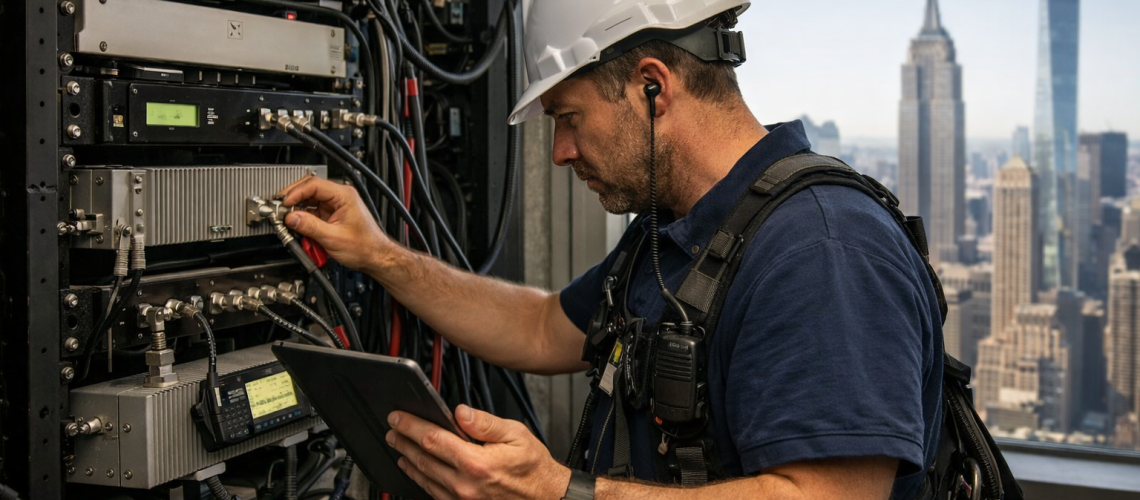
Key Takeaways
- Move emergency responder communication enhancement systems into schematic design, not punch-list season. In New York high-rises, late coordination around radio coverage can trigger change orders, ceiling rework, and certificate-of-occupancy delays.
- Clarify the language early—ERCES, ERRCS, BDA, and ARCS don’t mean the same thing in practice. The right in-building public safety communication approach depends on the AHJ, the adopted code chapter, and the fire department’s testing protocol.
- Reserve the right spaces before the floor plan hardens. Emergency responder communication enhancement systems need head-end room, backed-up power, pathways, and antenna locations in stairs, basements, elevator lobbies, and mechanical room areas.
- Treat aesthetics and radio code as one coordination problem. Donor signal paths, riser routing, and antenna placement will affect façade lines, core planning, and finished ceilings long before acceptance testing starts.
- Ask tougher procurement questions before bid day. A compliant emergency responder communication enhancement systems package should come with UL 2524 documentation, supervision details, battery backup data, propagation studies, and a realistic commissioning plan.
- Expect different coverage demands in hospitals, mixed-use towers, and transit-connected buildings. The closest passing test isn’t enough if black-box retail floors, parking levels, or ambulance access routes create dead zones for first responder radio service.
New York keeps building higher, deeper, and denser—yet radio coverage for fire, police, and medical teams still fails in the same places: stairs, cellar levels, elevator lobbies, and thick-walled core areas. That’s why emergency responder communication enhancement systems have moved from late-stage fire alarm add-on to front-end design risk. Miss it, and the problem usually doesn’t show up on paper. It shows up at turnover, during acceptance testing, with the certificate of occupancy hanging in the balance.
For architects, MEP engineers, and telecom consultants, the pressure is getting harder to ignore. Supertall towers, black-box retail floors, transit-linked podiums, and hospital-grade program space don’t forgive lazy assumptions about in-building public safety coverage. New York adds another wrinkle—local enforcement isn’t always playing by the same script as a typical city or state review path. And once head-end room space, riser routes, donor antenna locations, or battery backup get pushed too late, the fix isn’t cheap (or pretty). It’s a change order, a ceiling compromise, or a failed inspection waiting to happen.
Why emergency responder communication enhancement systems are back in focus as New York towers get taller
Taller towers change the risk.
And the problem usually stays hidden until testing day, when stairwells, elevator lobbies, basement service rooms, and thick concrete cores turn a clean radio beat into black spots for emergency services. That’s why emergency responder communication enhancement systems are back in active design review across New York, NY.
How supertall construction and deeper floor plates create radio dead zones for first responders
On supertall jobs, deeper floor plates and tighter mechanical center layouts can kill in-building emergency responder communication long before finishes go in. A properly engineered emergency responder radio booster system supports first responder radio coverage enhancement where ambulance, medical, and fire teams can’t afford dropped contacts.
Design teams are now comparing a first responder communication enhancement system, public safety communication enhancement system, and emergency responder signal enhancement plan during SD and DD—not after a failed acceptance test.
And that’s where most mistakes happen.
Why certificate-of-occupancy risk is pushing ERCES into earlier design conversations
CO risk. Plain and simple.
If the building can’t pass with a UL listed responder communication system and an AHJ approved responder radio system, turnover slips. Teams are specifying ERECS for emergency responders, a BDA system for emergency responders, and fire code compliant responder communication earlier for high rises, hospitals, and major commercial work.
Where New York, NY differs from other city and state code enforcement patterns
New York isn’t typical—far from it. Unlike other city and state patterns that treat ERCES for emergency responders as a late compliance item, New York often forces earlier coordination around emergency responder communication for high rises, emergency responder communication for hospitals, and emergency responder communication for commercial buildings.
- Early coordination: radio room, risers, and pathway space
- Inspection pressure: code compliant emergency responder radio enhancement
- Product scrutiny: emergency responder radio amplification system details
In practice, engineers like those at Marconi Technologies keep saying the same thing: if emergency responder communication enhancement systems aren’t addressed early, change orders show up late—and they’re never minor.
What emergency responder communication enhancement systems actually cover inside high-rise buildings
Think of it this way: emergency responder communication enhancement systems aren’t there to make a lobby sound better. Their job is to keep emergency radio traffic alive in the spots where signal usually goes black—stairs, below-grade levels, elevator lobbies, and every mechanical room that turns into a concrete box during an incident.
The core job of emergency responder communication enhancement systems in stairs, basements, mechanical room areas, and elevator lobbies
In practice, in-building emergency responder communication is about code-required coverage for the first people through the door. A proper emergency responder radio booster system supports stair towers, fire command center areas, pump rooms, electrical rooms, parking levels, and hospital service corridors where ambulance crews and fire teams can’t afford dead air.
Design teams usually look for:
- 95% floor area coverage under IFC-style testing
- 99% coverage in critical areas like stairs and the command room
- Battery backup, monitoring, and survivability features
How in-building public safety communication differs from consumer cellular DAS and Wi-Fi service
A public safety communication enhancement system is not the same thing as cellular DAS or Wi-Fi. Cellular service helps tenants, neighbors, contacts, and doctor paging apps; ERCES for emergency responders supports police, fire, and medical radio protocol on licensed bands. That’s a different risk profile—and a different inspection path.
ERCES, ERRCS, BDA, and ARCS: the terms design teams mix up and what each one means in practice
Here’s the short version. first responder communication enhancement system, ERECS for emergency responders, and ERRCS are often used almost interchangeably, depending on the city or state code chapter. A BDA system for emergency responders is the amplifier piece inside that setup, while ARCS usually points to New York-specific radio service architecture. For high-rise teams chasing a CO, that naming confusion causes change orders fast. The fix is simple: specify a UL listed responder communication system, confirm a AHJ approved responder radio system, and require code compliant emergency responder radio enhancement early. Marconi Technologies has noted that this is where submittals usually go sideways.
That matters for emergency responder communication for high rises, emergency responder communication for hospitals, and emergency responder communication for commercial buildings alike. The right emergency responder signal enhancement, emergency responder radio amplification system, first responder radio coverage enhancement, and fire code compliant responder communication package keeps radio traffic clear when the building is working against it.
Simple idea. Harder to get right than it sounds.
New York designers are finding out the hard way that aesthetics and radio code now collide
Tall towers in New York now force life-safety radio design into plain view.
- Façade and rooflines.Why antenna placement, donor signal paths, and riser routing affect façade, ceiling, and core designA concealed antenna can wreck donor signal strength, — a badly placed riser can eat rentable room in the core. For first responder radio coverage enhancement, teams need early path studies for black spots, stair pressurization zones, and transfer points—before ceilings close.
- Space planning.How architects and MEP engineers can reduce change orders by coordinating head-end room, power, and pathway space earlyThe cleanest fix is boring coordination. A in-building emergency responder communication layout needs a dedicated head-end room, 24-hour backup power, rated pathway space, and service access; miss any one of those and the BDA system for emergency responders turns into a late RFI chain.Teams specifying an emergency responder radio booster system or a first responder communication enhancement system should also define fire code compliant responder communication, code compliant emergency responder radio enhancement, — an AHJ approved responder radio system on the permit set.Most guides gloss over this. Don’t.
- Turnover risk.The inspection failures showing up most often before turnover — and how to avoid themThe repeat failures are predictable: weak stair coverage, missing battery calcs, no acceptance test protocol, unlabeled coax, and no proof of a UL listed responder communication system. That hits emergency responder communication for high rises first, but emergency responder communication for hospitals and emergency responder communication for commercial buildings are seeing the same issue.On dense urban jobs, emergency responder signal enhancement, ERCES for emergency responders, ERECS for emergency responders, emergency responder radio amplification system, and public safety communication enhancement system details should be coordinated with the city and hospital radio contacts early (as Marconi Technologies has pointed out on FDNY-facing work).
What code-focused teams should ask before specifying emergency responder communication enhancement systems
Is the system scope really clear once the radio consultant says coverage is weak? Not even close. In practice, emergency responder communication enhancement systems get projects in trouble when the drawings stop at a generic note and nobody pins down who enforces what.
Which AHJ, fire department, and adopted code chapter control the project
Start with the AHJ, local fire department, and adopted IFC, NFPA, or city amendment chapter. A Manhattan tower, an ohio hospital, and a transit-linked center won’t get reviewed the same way. A public safety communication enhancement system has to match the jurisdiction’s service rules before design development moves another inch.
What signal testing, battery backup, supervision, and monitoring protocol must be shown on drawings
Drawings should call out donor testing, uplink and downlink levels, battery runtime, alarm supervision, and contacts to the fire alarm or command room. That’s where an emergency responder signal enhancement package either looks real—or looks like value engineering bait. For fire code compliant responder communication, teams should show:
- 24-hour standby and 12-hour or code-required backup
- Annunciator location
- Supervised coax, antenna, and power paths
How hospitals, mixed-use towers, transit-connected buildings, and black-box retail floors create different coverage demands
Hospitals have medical imaging rooms, ambulance bays, and shielded care areas. Mixed-use towers add parking, mechanical floors, neighbors above retail, and black floor plates that kill first responder radio coverage enhancement. That changes the need for an emergency responder radio booster system, a BDA system for emergency responders, and emergency responder communication for hospitals or commercial buildings.
Why shop drawings, propagation studies, and acceptance testing matter more than a generic basis-of-design note
Generic notes don’t pass inspection. Shop drawings, propagation studies, and acceptance testing prove an emergency responder communication for high rises or in-building emergency responder communication layout can actually work—especially where a UL listed responder communication system, AHJ approved responder radio system, or first responder communication enhancement system is required. Marconi Technologies is one manufacturer that works in this space, but the honest answer is simpler: code compliant emergency responder radio enhancement gets approved on documentation, not branding. Teams should also verify ERCES for emergency responders, ERECS for emergency responders, emergency responder radio amplification system, and emergency responder communication for commercial buildings before permit.
The buying and specification decision: what transactional search intent really means for emergency responder communication enhancement systems
Nearly 8 out of 10 late-stage coverage fixes in dense urban towers start the same way: the team treated emergency responder communication enhancement systems like a commodity package instead of a code-triggered design scope. That’s the expensive miss—especially in New York, where one failed test can push a certificate of occupancy, hold hospital care areas, or send a commercial building back for rework.
What specifiers need from a manufacturer or design partner before bid day
Bid documents need more than a generic public safety communication enhancement system note. They need a defined emergency responder radio booster system, a first responder communication enhancement system basis of design, and verified pathways for in-building emergency responder communication in black stairwells, fire command center room locations, ambulance bays, and medical support floors.
How to compare UL 2524 documentation, listing status, support model, and commissioning readiness
Specifiers should compare four items:
- UL listed responder communication system paperwork
- AHJ approved responder radio system history
- Field support for emergency responder signal enhancement
- Commissioning plan for a BDA system for emergency responders or ERCES for emergency responders
The honest answer is simple: if the vendor can’t show listing status, battery protocol, donor antenna details, and final test steps, the fire code compliant responder communication claim isn’t ready for bid.
What a realistic procurement and inspection timeline looks like in New York, NY right now
In practice, a realistic path for code compliant emergency responder radio enhancement runs 8 to 14 weeks—submittals, shop drawings, install, sweep testing, punch list, retest. For emergency responder communication for high rises, emergency responder communication for hospitals, and emergency responder communication for commercial buildings, delays usually hit at commissioning.
Where experienced manufacturers such as Marconi Technologies can add technical input without taking over the article
And that’s exactly where an experienced manufacturer such as Marconi Technologies can help—reviewing ERECS for emergency responders, confirming first responder radio coverage enhancement, and checking whether an emergency responder radio amplification system actually matches local code, city contacts, and responder service expectations before bid day.
Frequently Asked Questions
What is the emergency responder communication enhancement system?
An emergency responder communication enhancement system, often called ERCES, is an in-building radio system that improves public safety radio coverage for fire, police, ambulance, and other emergency services inside structures where signal drops out. It usually includes a donor antenna, bi-directional amplifier or dedicated radio equipment, coax, splitters, and indoor antennas to cover stairwells, basements, parking decks, elevator lobbies, and other black spots. If first responder radios can’t reach dispatch or the command center, the building has a life-safety problem. That’s what this system is there to fix.
What is the 3 3 3 rule for ham radio?
The 3-3-3 rule is a ham radio operating guideline, not a building code rule for emergency responder communication enhancement systems. People use it in amateur radio to mean trying three times, on three frequencies or channels, for about three minutes each, but it isn’t part of IFC, NFPA, UL 2524, or public safety ERCES acceptance testing. Good to know, but it won’t help on an AHJ inspection.
What is the difference between ERCES and ERRCS?
In practice, ERCES and ERRCS are usually talking about the same type of in-building public safety radio system. Different cities, state agencies, consultants, and code chapters use different wording: Emergency Responder Communication Enhancement Systems versus Emergency Responder Radio Communication Systems. The equipment, testing, and inspection issues are usually more important than the acronym.
What are examples of emergency communication systems?
Examples include ERCES for first responder radio coverage, fire alarm voice evacuation, nurse call and hospital paging, mass notification systems, area of refuge communication, and dispatch-linked two-way radio systems. A hospital, medical center, or memorial campus may also have code blue paging, doctor contacts lists, ambulance radio links, and emergency phones. Not every emergency system is ERCES, and mixing them up early in design causes coordination problems later.
When is an emergency responder communication enhancement system required in a building?
It’s required when the adopted fire code, building code, or local protocol says the building must provide minimum radio coverage for public safety agencies and the signal test fails. That usually shows up in high-rises, hospitals, parking structures, tunnels, large mixed-use projects, and dense concrete or steel buildings where first responders hit dead zones. The honest answer is simple: if the AHJ can’t get reliable radio service in critical areas, the project is heading toward an ERCES requirement.
No shortcuts here — this step actually counts.
What codes and standards apply to ERCES?
The big ones are the International Fire Code, NFPA 1225 (which replaced older language from NFPA 1221), and UL 2524 for in-building two-way emergency radio communication enhancement systems. Local rules still matter just as much—some city and state requirements add battery backup, active monitoring, annunciation, NEMA ratings, survivable pathways, or donor antenna limits. Always check the adopted code edition, not the one someone used on a job in Ohio two years ago.
How does ERCES affect architects and MEP engineers during design?
More than most teams expect. Room allocations, riser routing, rated pathway details, roof antenna placement, power from the right panel, battery cabinet space, and coordination with fire alarm monitoring all need to be settled before walls close up. Miss that, and you’ll get change orders, ugly exposed devices, and a bad conversation right before the certificate of occupancy.
What areas of a building usually need ERCES coverage testing?
AHJs usually focus on critical areas first: fire command center, stairwells, elevator lobbies, standpipe cabinets, pump rooms, generator rooms, fire control room, basements, and parking levels. But acceptance testing often covers the whole building on a grid, not just the obvious rooms, because black spots show up in strange places—behind shafts, inside mechanical rooms, near reinforced cores. That’s where teams get surprised.
Can a hospital or medical campus have different ERCES needs than an office tower?
Yes, and the differences are real. Hospitals, trauma centers, and care campuses have more shielded rooms, imaging areas, equipment-heavy floors, and around-the-clock operations, so installation phasing and radio testing can get touchy fast. A medical building also has more life-safety interfaces to protect during shutdowns, which means tighter coordination with facilities, security, and clinical staff.
What causes most ERCES inspection failures?
Three common patterns: poor donor signal assumptions, weak coverage in stair or below-grade areas, — missing supervision on critical components. Add bad as-builts, wrong labels, unapproved substitutions, or a battery calculation that doesn’t match installed gear, and the inspector is going to stop the job. As one manufacturer source, Marconi Technologies, has pointed out in the field, inspection readiness usually comes down to early coordination and clean documentation—not heroics at the end.
And that’s where most mistakes happen.
New York’s taller towers are forcing a hard reset in how life-safety radio systems get planned. What used to be treated as a late-stage specialty package now affects core layout, shaft space, head-end room planning, backup power, ceiling coordination, and inspection sequencing much earlier than some teams expect. Miss that shift, and the result usually isn’t minor. It’s a failed acceptance test, a scramble before turnover, and a certificate-of-occupancy problem nobody has time for.
That’s the real issue: emergency responder communication enhancement systems aren’t just another low-voltage line item. In high-rise work across New York, they sit right at the intersection of code, constructability, — building appearance — and that collision is getting harder to ignore as towers get taller and floor plates get deeper. Teams that separate ERCES, ARCS, BDA, and in-building public safety communication requirements early tend to avoid the ugliest change orders later (and the ugliest meetings, too).
The next move is simple. Before design development goes any further, the project team should confirm the controlling AHJ path, require a propagation study and testing basis in the design package, and review UL 2524 documentation and commissioning readiness before bid day. That work belongs on this month’s coordination agenda, not the punch list.
Marconi Technologies
New York, NY 10006
(212) 376-4548
https://www.marconitech.com/