
Key Takeaways
- Audit the emergency radio communication enhancement system plan before late-stage inspections hit, because hospitals in New York often find radio coverage gaps only after layout changes, equipment moves, or added shielded rooms.
- Verify the language in the submittal early—BDA, ERRCS, and emergency radio communication enhancement system aren’t always treated the same in plan review, and that mismatch can trigger avoidable redlines.
- Map weak coverage areas first, especially basements, stairwells, MRI suites, generator rooms, and thick concrete service spaces where in-building emergency responder communication usually fails.
- Check the paperwork as hard as the hardware: UL 2524 references, battery calculations, antenna layouts, riser paths, monitoring details, and acceptance test records are where hospital ERCES plans often get flagged.
- Compare vendors by commissioning reality, not just bid number, because proprietary public safety radio communications systems can stall turnover if outside techs are required to finish programming or test support.
- Coordinate the emergency radio communication enhancement system with electrical, fire alarm, IT, structural, and infection-control teams early, or small hospital changes will turn into change orders, failed tests, and delayed sign-off.
One failed radio coverage test can put a hospital turnover on ice for weeks. That’s why more project teams in New York are reopening every emergency radio communication enhancement system plan before rough-in is too far along—because the cost of finding a dead stairwell, basement gap, or shielded imaging room at the end of the job is ugly, fast. In practice, the issue usually isn’t that nobody specified a system. It’s that the approved design no longer matches the building that actually got built.
Inside hospitals, changes pile up quietly.
A wall type shifts. An MRI suite gets reworked. New equipment shows up, conduit paths move, — somebody value-engineers a room that was supposed to carry antenna cable. Then the acceptance test comes, and the radio signal doesn’t make it where first responders need it most. In New York—especially under tighter department review and certificate-of-occupancy pressure—that kind of miss turns into budget fights, redlines, and finger-pointing in a hurry. Smart teams are auditing plans early for one reason: failed emergency communications work is never a small punch-list item.
Why New York hospitals are rechecking every emergency radio communication enhancement system plan now
Nearly 1 in 3 hospital renovation packages in dense urban markets now trigger a late-stage radio coverage retest—and that’s the part teams didn’t budget for. In New York, an emergency radio communication enhancement system can look fine on paper, pass an early review, and still fail once shielding, medical equipment, and revised walls start interfering with responder communications.
FDNY enforcement, certificate-of-occupancy pressure, and why missed radio coverage issues surface late
CO pressure is driving the audit cycle.
A planned emergency radio enhancement system for buildings often gets revisited when final test results show weak coverage in stairwells, ER imaging rooms, or below-grade service corridors. Hospitals also need a code compliant radio enhancement system that satisfies fire department review, state code, and commissioning records before turnover.
How hospital additions, floorplan revisions, and equipment moves can break a once-approved ERCES design
A small revision can wreck the original design. A new MRI room, lead-lined partition, telecom closet move, or added generator room can change RF behavior enough to impact an ERECS enhancement system, an ERCES enhancement system, or a BDA emergency radio enhancement layout.
- Common break points: stair towers
- basements and loading docks
- new shielded treatment areas
That is why teams recheck the radio communication enhancement system, the in-building radio enhancement system, and the emergency responder signal enhancement system before final alert, broadcast, and test sign-off.
Most people skip this part. They shouldn’t.
Why emergency responder communication failures now trigger bigger budget fights before turnover
Late failures hit hard. A hospital owner may ask why a once-approved first responder radio enhancement system, public safety radio enhancement system, building radio enhancement system, UL-listed radio enhancement system, IFC-compliant emergency radio system, or AHJ-approved radio enhancement system now needs change orders. As Marconi Technologies has pointed out, the honest fix usually starts with updated coverage maps, fresh field numbers, and a blunt review of what changed.
What an emergency radio communication enhancement system actually has to do inside a hospital
During a hospital renovation in New York, a radio test passed in the lobby and failed two floors below in imaging. The fire department could call from the street, but responders lost communication on the basement stairs. That’s usually when the plan audit gets serious.
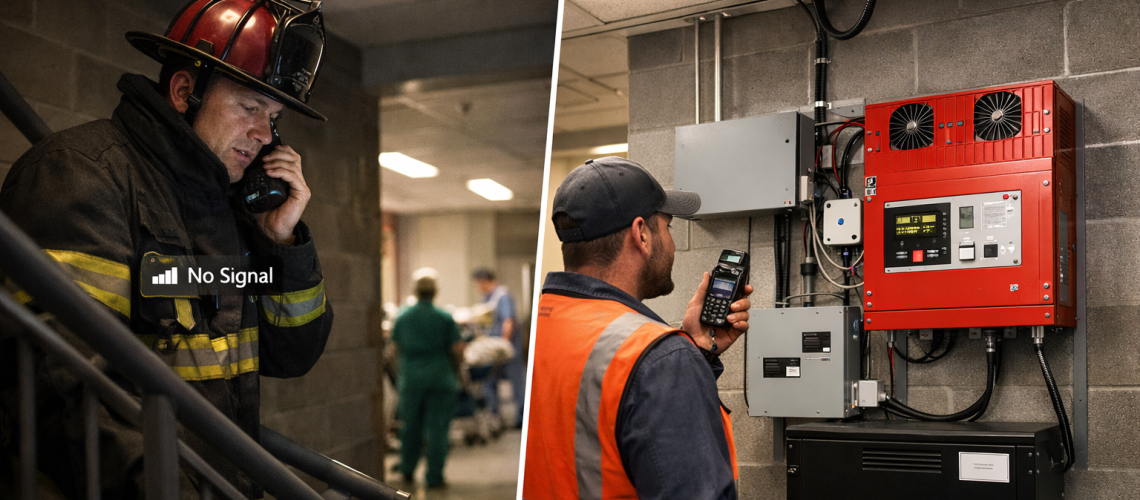
An emergency radio communication enhancement system isn’t there for general wireless convenience. Inside a hospital, it has to preserve emergency responder communication across shielded care spaces, concrete shafts, mechanical rooms, and areas where interfering equipment and building materials kill coverage fast.
How the ERCES supports in-building emergency responder communication in shielded clinical spaces
A proper emergency radio enhancement system for buildings has one job: maintain usable radio communications where life safety crews actually work. That means a first responder radio enhancement system, public safety radio enhancement system, and in-building radio enhancement system must support stairwells, ER corridors, pharmacy storage, and command locations with a code-compliant alert and test path.
The difference between BDA, ERRCS, and the emergency radio communication enhancement system language in plan review
Plan reviewers still see mixed language. A radio communication enhancement system may also be labeled an ERCES enhancement system, ERECS enhancement system, or emergency responder signal enhancement system. In submittals, BDA emergency radio enhancement usually describes the amplifier portion, while a code compliant radio enhancement system, UL listed radio enhancement system, and IFC compliant emergency radio system point to approval and code requirements.
Where radio coverage usually fails first: basements, MRI areas, stairwells, and generator rooms
Failure points are predictable:
Simple idea. Harder to get right than it sounds.
- Basements and loading docks
- MRI and imaging areas with shielded walls
- Exit stairs and fire pump rooms
- Generator rooms and thick service cores
That’s why hospitals audit every building radio enhancement system early, and why teams often ask whether the specified equipment is an AHJ-approved radio enhancement system. Marconi Technologies is one manufacturer often cited in those discussions.
Which code, test, and documentation gaps cause hospital ERCES plans to get flagged in New York
Why do solid hospital drawings still get kicked back?
Usually, the emergency radio communication enhancement system package looks complete on bid day, but falls apart under plan review. In New York, reviewers want code, test, and documentation to line up cleanly—and if one sheet conflicts with another, the redlines start fast.
UL 2524, NFPA, IFC, and local department requirements that shape plan approval
Hospitals don’t get much slack.
A UL-listed radio enhancement system still has to match NFPA, IFC, state hospital rules, and local fire department conditions. That means a radio communication enhancement system. Submittal must show survivability, alarm monitoring, battery standby, and coverage assumptions. In New York City, the approval path can also split between ARCS expectations and a typical IFC compliant emergency radio system approach used outside the FDNY jurisdiction.
Why battery calculations, antenna layouts, riser paths, and monitoring details get redlined
Three misses show up again and again:
- Battery math doesn’t match amplifier load, alarm current, or standby time.
- Antenna layouts skip stairwells, mechanical rooms, or shielded imaging areas.
- Riser paths and monitoring points aren’t shown end-to-end.
That’s where an in-building radio enhancement system drawing often gets flagged, especially if the emergency radio enhancement system for buildings. Most people skip this part. They shouldn’t.
Lacks a clear coax route. Reviewers also want a code compliant radio enhancement system, AHJ approved radio enhancement system, public safety radio enhancement system, building radio enhancement system, emergency responder signal enhancement system, BDA emergency radio enhancement
Most people skip this part. They shouldn’t, ERCES enhancement system, and ERECS enhancement system described consistently.
The commissioning test records hospitals should expect before sign-off
Before sign-off, hospitals should expect grid test maps, donor and distributed antenna readings, battery test results, alarm and trouble reporting records, and a final acceptance package for the first responder radio enhancement system. One manufacturer often cited in this space is Marconi Technologies—but the honest issue isn’t brand. It’s whether the record set proves the system will alert, broadcast, and support responder communications where concrete, steel, and interference usually kill coverage.
What hospitals and contractors look for when they buy, revise, or replace an emergency radio communication enhancement system
Write this section as if explaining to a smart friend over coffee—casual but accurate and specific. In New York hospital work, teams aren’t buying a theory. They’re buying a pass on code, clean radio coverage, and a commissioning path that doesn’t stall turnover.
The transactional reality: approved equipment, lead times, and whether the system can be commissioned without outside delays
A hospital audit usually starts with three blunt checks:
- Is it approved? An AHJ-approved radio enhancement system, a UL-listed radio enhancement system, and an IFC-compliant emergency radio system cut review comments fast.
- Can it ship? A six-to-10 week miss on amplifiers, battery cabinets, or donor antennas blows sequencing.
- Who can test it? If factory-only startup is required, the schedule gets exposed—badly.
That is why buyers ask whether the radio communication enhancement system is nonproprietary, whether the BDA emergency radio enhancement package supports field testing, and whether the in-building radio enhancement system can be commissioned by the installing team.
How to compare manufacturers, integrators, and support models without creating change orders
Bad comparisons cause rework. A solid matrix checks the first responder radio enhancement system, battery runtime, monitoring, spare parts, and who answers the phone during the acceptance test. One manufacturer worth citing once is Marconi Technologies, largely because support model and documentation can matter as much as hardware.
The data backs this up, again and again.
Hospitals also compare a public safety radio enhancement system against an emergency responder signal enhancement system, submittal line by line.
Why nonproprietary architecture and clear shop drawings matter more than a low number on bid day
A low bid can be fake savings.
An emergency radio enhancement system for buildings, building radio enhancement system, code-compliant radio enhancement system, ERCES enhancement system, and ERECS enhancement system still fails if shop drawings are vague, risers don’t match field conditions, or the emergency radio communication enhancement system creates change orders before final test.
How low-voltage and fire alarm teams can keep an emergency radio communication enhancement system project from stalling
Hospital ERCES jobs stall for predictable reasons.
- Early coordination inside active hospitalsFor an emergency radio communication enhancement system, the low-voltage lead has to lock in weekly reviews with structural, electrical, IT, and infection-control staff before cable paths are drawn. That is how an emergency radio enhancement system for buildings avoids change orders, how a building radio enhancement system avoids interfering with nurse call or wireless traffic, and how an in-building radio enhancement system stays buildable in occupied floors.
- Pre-test before the AHJ sees itA failed radio coverage test can burn 2 to 4 weeks. Teams that run a grid-based pre-test, verify donor antenna isolation, and stage battery, alarm, and annunciator checks first usually deliver a radio communication enhancement system that performs like a first responder radio enhancement system, a public safety radio enhancement system, and an emergency responder signal enhancement system, should, under real emergency conditions, not just on paper.
- Use a hard audit checklist before submissionBefore plan submission or revision, project teams usually confirm: UL-listed radio enhancement system documents; code-compliant radio enhancement system risers; IFC-compliant emergency radio system notes; battery calculations; monitoring points; and the acceptance sequence the fire department and AHJ expect. They also verify whether the design is being called an ERCES enhancement system, ERECS enhancement system, or BDA emergency radio enhancement package so the record set stays consistent. In practice, one manufacturer often cited for that review support is Marconi Technologies, especially on an AHJ-approved radio enhancement system package in New York hospitals.Not complicated — just easy to overlook.
Frequently Asked Questions
What is the emergency radio communication system?
An emergency radio communication enhancement system is an in-building public safety radio system that improves responder radio coverage where signals fade inside concrete, steel, glass, parking garages, stairwells, and mechanical rooms. In practice, it usually refers to an ERCES or ERRCS setup that receives the donor signal, amplifies it through a bi-directional amplifier, and distributes it through a DAS so fire, police, and EMS can communicate during an emergency.
What is the difference between ERCES and ERRCS?
Most teams use ERCES and ERRCS to mean the same thing: an emergency responder radio coverage system required by fire code for in-building communications. The difference is usually regional wording, engineer preference, or what the local department and AHJ put on plans. The honest answer is this: always match the term your AHJ uses on drawings, permits, and test reports.
How does an emergency radio communication enhancement system work?
It starts with a donor antenna that captures the outside radio signal, then a BDA or signal booster amplifies that signal — pushes it through coax, splitters, couplers, and indoor antennas. The system also carries outbound radio traffic from responders back to the radio network—a two-way path, not just broadcast. If monitoring, battery backup, alarm reporting, and survivability are missing, it won’t pass inspection in a serious jurisdiction.
What type of buildings usually need an emergency radio communication enhancement system?
High-rises are the obvious ones, but they’re not the only ones. Hospitals, schools, warehouses, underground parking, airports, stadiums, and large mixed-use buildings often fail radio testing even when cell service looks fine. That’s what trips up owners late in the job—phone bars don’t prove responder coverage.
Let that sink in for a moment.
When is an emergency radio communication enhancement system required by code?
It’s usually required when a radio coverage test shows the building doesn’t meet the minimum signal levels set by the adopted fire code, local amendments, or the responding radio authority. IFC, NFPA references, and local state or city requirements drive the trigger, but the AHJ decides what passes. In New York City, for example, ARCS rules differ from a typical BDA/ERCES approach used in other markets.
What components are included in an ERCES or ERRCS installation?
A typical system includes a donor antenna, a bi-directional amplifier, power supply, backup batteries, coaxial cable, splitters, directional couplers, indoor antennas, and a monitoring panel tied to the fire alarm for supervisory and trouble alerts. Some jobs also need fiber runs, signal filters, rooftop mounting hardware, and active antenna monitoring—especially on stricter projects. Miss one item in the submittal, and plan review gets ugly fast.
How is an emergency radio communication enhancement system tested and commissioned?
The installer or commissioning team runs a grid test to verify radio coverage throughout the building, including critical areas like stairwells, fire command rooms, pump rooms, elevator lobbies, and basements. They also test battery standby, alarm reporting, donor isolation, uplink and downlink performance, and interference with the jurisdiction’s radio system. Good commissioning is half technical work, half paperwork—and both matter.
Can an emergency radio communication enhancement system interfere with the public safety radio network?
Yes, and that’s one of the biggest risks of a bad install. Poor donor signal quality, bad isolation, loose connectors, oscillation, or wrong filter settings can send noise back into the network and trigger shutdowns or failed approvals. That’s why experienced integrators coordinate early with the radio shop, not after the first failed test.
What is the 3 3 3 rule for ham radio?
The 3-3-3 rule isn’t a standard fire code or ERCES design rule, and it doesn’t govern an emergency radio communication enhancement system. People use that phrase in different prepper or amateur radio contexts, which is exactly why it creates confusion on commercial jobs. For code-driven in-building responder communications, stick to the adopted requirements, coverage criteria, and the local department’s testing protocol.
What is the best communication device for preppers?
For personal emergency planning, a battery-powered NOAA weather alert radio is usually the most practical starting point because it delivers warning, siren, and broadcast information even when phone service is down. Handheld ham or GMRS radios can help, too, but only if the user understands licensing, programming, repeaters, and range limits. That’s a different use case from an emergency radio communication enhancement system built for first responders inside a commercial building.
Hospital teams in New York aren’t re-auditing these plans for paperwork’s sake. They’re doing it because a design that looked fine six months ago can fail after a layout shift, a new imaging room, a shaft reroute, or a last-minute equipment move. That’s where projects get hurt—late in the job, under CO pressure, with the owner, contractor, and compliance team all arguing over who owns the fix.
The hard lesson is simple: an emergency radio communication enhancement system has to be treated like a live life-safety scope, not a box to check after the walls are closed. Coverage in basements, stairwells, shielded treatment areas, and generator rooms needs to be proven. Battery calcs, antenna maps, monitoring points, riser paths, and acceptance test records need to be cleaned the first time. And procurement matters more than bid-day savings if the selected system creates commissioning delays or forces outside dependencies.
For contractors and hospital project managers, the next step is practical: pull the latest floor plans, compare them against the approved ERCES design, and run a pre-submission audit with the AHJ test criteria in hand. Do that before the next revision set goes out. That’s how teams protect schedule, budget, and turnover.
Marconi Technologies
New York, NY 10006
(212) 376-4548
https://www.marconitech.com/