
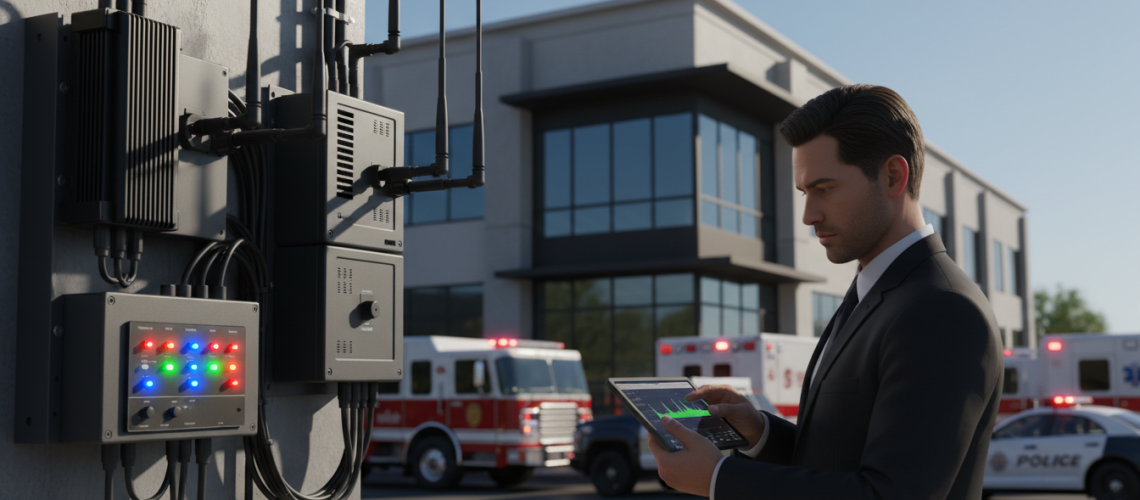
You walk into a new office tower with plaster, metal, and tinted glass everywhere. A few months later, a fire crew reaches the third floor and suddenly loses contact. They stand in a stairwell with no clear signal and must shout to be heard.
That moment highlights why design and testing matter. Modern construction often blocks signal paths, and if your ERRCS installation misses local requirements, your building’s safety and compliance hang in the balance.
Good planning during construction saves time and money. Proper installation, careful testing, and attention to system design keep responders connected in hallways and stairways. Reliable communication is not a luxury — it’s a safety requirement that protects occupants and crews.
Key Takeaways
- Modern materials can reduce signal strength inside buildings.
- Early ERRCS design and installation cut costly delays.
- Testing and compliance ensure responders stay connected.
- Proper design protects occupant safety and building compliance.
- Address issues during construction to avoid fixes later.
Why Your Building Needs Reliable Radio Coverage
A dependable in-building network gives your responders the clarity to coordinate fast. First responders depend on steady communication in stairwells, basements, and isolated zones of a building. When signals drop, your team can’t get updates or share hazards.
Public safety networks cover wide areas, but modern materials often block those signals inside buildings. A properly designed public safety DAS or BDA fills gaps and keeps communications consistent where it matters most.
Building owners must treat coverage as a safety requirement, not an optional upgrade. Installing a robust DAS helps you meet local requirements and gives first responders the lifeline they need during an emergency.
- Better coordination: Clear signals let crews exchange real-time info.
- Compliance: Meets safety and inspection requirements for many buildings.
- Reduced risk: Fewer dead zones improve occupant and responder safety.
Common Reasons Emergency Radio Systems Fail Inspection
Small design missteps can leave whole floors with little or no signal when it counts. You can pass an initial check and still hit problems during a formal inspection if documentation, testing, or power backups are missing.
Signal Strength Issues
Weak coverage in stairwells, basements, or remote zones often shows up during testing. NFPA 1221 and 1225, plus IFC Section 510, set the standards you must meet for verification.
Antenna Placement Errors
Damaged or poorly polarized antennas reduce signals through walls and modern materials. Proper installation and alignment help first responders and keep your building compliant with FCC Part 90 rules.
Backup Power Failures
Lack of reliable backup — dead batteries or a faulty generator — will trip a failed result. Keep maintenance logs and test results for the Authority Having Jurisdiction to prove compliance.
| Issue | Code / Test Reference | Quick Action |
|---|---|---|
| Weak coverage in zones | NFPA 1221, field testing | Add antennas or amplifiers |
| Misaligned antennas | FCC Part 90, local code | Repair or reposition antenna |
| Backup battery failure | IFC §510, annual tests | Replace batteries; log maintenance |
| Missing documentation | AHJ requirements | Compile installation and testing records |
Understanding the Role of Modern Construction Materials
Dense modern construction often puts a literal wall between you and reliable indoor connectivity.
Reinforced concrete, structural steel, and Low-E glass can block or weaken radio signals inside a building.
Energy-efficient insulation also affects penetration. It often absorbs or reflects frequencies, so signals lose strength before they reach key zones.
Impact of Modern Building Materials
The larger and more complex the structure, the more pronounced the degradation.
That reality makes DAS design and proper installation critical. You need amplification and antenna placement that account for dense materials.
Annual testing and design audits keep the system tuned as interiors change. This helps maintain coverage and meet IFC Section 510 and other code requirements for public safety.
| Material | Effect on Signals | Practical Solution |
|---|---|---|
| Reinforced concrete | High attenuation; blocks many frequencies | Use additional antennas and amplifiers; adjust placement |
| Structural steel | Reflects and scatters signals | Strategic DAS layout; shielding-aware design |
| Low-E glass / insulated glazing | Reflects outdoor signals; reduces penetration | Interior repeaters and window-penetrating antennas |
| Energy-efficient insulation | Absorbs radio waves | Design audits and targeted amplification |
Professional design services can map how materials affect communication and propose solutions that meet code and keep responders connected during a fire or other incidents.
Essential Components for System Functionality
The right hardware and placement turn external signals into dependable communication inside complex structures.
A Bi-Directional Amplifier (BDA) captures outdoor transmissions, boosts them, and pushes them into the building through a network of antennas. That amplification keeps signal strength steady in basements and stairwells so your emergency responder teams can stay connected.
Bi-Directional Amplifiers
BDAs link the public safety feed to your internal network. Technicians perform RF surveys before and after installation to verify power levels and coverage patterns.
Annual checks confirm backup batteries meet runtime requirements and the unit meets local code and jurisdiction rules.
Distributed Antenna Systems
For larger or multi-floor buildings, a DAS distributes signals evenly. Proper layout prevents dead zones across floors and shared zones.
During inspections each antenna location is tested for output, physical damage, and pattern conformity. Monitoring fault logs and system alarms lets you address issues before they affect responders.
- Quick checks: RF survey reports and installation records.
- Upkeep: Battery capacity testing and alarm monitoring.
- Coverage proof: Per-antenna power and pattern results for compliance.
Best Practices for Maintaining Ongoing Compliance
A disciplined maintenance plan preserves design intent and helps your building pass recurring checks.
Follow UL 2524 certification and aim for a Delivered Audio Quality (DAQ) of at least 3.0 in 95% of general areas. Annual maintenance audits should re-evaluate the system against original design and local code requirements.
Building owners must keep detailed documentation. Logbooks should record every test, battery swap, repair, and annotated grid test map used during inspections.
Load test backup batteries to verify the required 12–24 hour capacity. Train your facility team to spot alarms, report faults, and support an emergency responder team during drills.
| Practice | Benefit | Frequency |
|---|---|---|
| UL 2524 & DAQ verification | Meets code requirements and improves signal strength | Annual / after upgrades |
| Battery load testing | Ensures backup runtime for outages | Annual |
| Detailed logbooks & maps | Simplifies AHJ review and Certificate of Occupancy renewal | Continuous / updated after work |
“Partner with certified providers to keep design, installation, and inspections aligned with evolving codes.”
Keep testing, document everything, and schedule audits. That routine protects occupants, supports first responders, and keeps your building in compliance.
Conclusion
Consistent upkeep and smart documentation protect your building’s safety posture. Your ERRCS must stay ready so occupants and first responders get reliable help when needed.
As a building owner, prioritize routine testing, audits, and clear records to meet local code and compliance expectations.
Work with certified experts to keep coverage, signal strength, and communication channels stable. Practical solutions — including DAS and battery checks — reduce risk and protect the Certificate of Occupancy.
Proactive care shows you value occupant safety and supports responders during a crisis. Treat your ERRCS as a vital lifeline that needs steady attention.
FAQ
Why does my building need reliable radio coverage for first responders?
You want responders to communicate without delay during a fire or security event. Good indoor coverage helps firefighters, police, and EMS coordinate inside stairwells, mechanical rooms, and large open areas. It also supports code compliance with local jurisdictions and speeds inspections.
How do signal strength issues show up during testing?
Testers record low or fluctuating signal levels across floors and tenant spaces. You’ll see dropped calls, poor data throughput, or failed emergency responder radio coverage tests. These problems often point to dead zones, improper antenna gain, or inadequate DAS design.
What problems arise from poor antenna placement?
Wrong placement reduces coverage and causes interference. Antennas tucked behind concrete or metal, or placed too far from riserous cabling paths, lead to uneven signals. Proper mounting in corridors, shafts, and on rooftops prevents shadowing and helps achieve uniform coverage.
How do backup power failures affect compliance and safety?
If batteries or generators aren’t maintained, the system won’t work during a power outage. Inspectors look for reliable battery runtime, automatic switchover, and documented maintenance. Without that, the system can fail when you need it most.
Can modern construction materials block signals?
Yes. Low-e glass, metal cladding, concrete with rebar, and foil-backed insulation all attenuate signals. You may need additional antennas, repeaters, or DAS components to overcome these barriers and meet coverage requirements.
What role do bi-directional amplifiers play?
BDA units boost weak outdoor signals into the building and send interior traffic back to the network. A properly sized and tuned BDA keeps signal levels within acceptable ranges and prevents oscillation or overload that can fail testing.
Why install a distributed antenna system (DAS)?
A DAS distributes coverage evenly across large or dense buildings. It reduces dead spots in elevators, basements, and tenant suites. Inspectors often expect a DAS in high-rise, hospital, or campus environments to meet public safety radio requirements.
What documentation do inspectors expect during testing?
Bring design drawings, equipment make and model, test reports, power and battery logs, and maintenance records. Manufacturers’ installation guides and jurisdictional permits also help streamline the review.
How often should you test and maintain your system?
Schedule annual or semi-annual tests and battery checks, and update software and firmware as recommended. Regular inspections catch degraded performance before an emergency or compliance audit.
What are quick fixes to improve failing coverage?
Start with optimizations: relocate or retune antennas, add passive components like coax or splitters, replace degraded cables, or adjust amplifier gain. If those don’t help, plan for additional DAS nodes or a professional redesign.
Who should you hire to evaluate and repair the installation?
Use certified public safety communications contractors or integrators experienced with NFPA and local codes. Look for technicians familiar with in-building wireless, BDAs, DAS design, and fire department liaisons.
How do jurisdictional requirements affect acceptance?
Local fire marshals and AHJs set testing criteria—signal thresholds, coverage maps, and documentation standards vary. Coordinate early with the AHJ to avoid rework and to ensure your system meets all code and life-safety expectations.