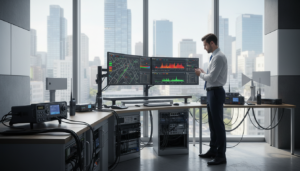

During a late-night drill, a facilities manager watched first responders kneel beside a stairwell and raise their handsets only to get silence. That moment made it clear: indoor signal gaps can cost time and risk lives. You want your building to support clear communications when seconds matter.
Since 2009, the International Code Council and the National Fire Protection Association set rules to ensure reliable in-building coverage for those who enter a structure to help others. This guide shows how the system works and what you should check in your facility.
We will cover the key steps to meet public safety radio standards and keep your staff and responders safe. Expect practical tips on testing signal strength, choosing the right coverage approach, and keeping your site compliant with modern safety rules.
Key Takeaways
- You can prevent dangerous signal gaps with proper in-building coverage planning.
- Codes introduced in 2009 require reliable communications for first responders.
- Testing and maintenance keep your safety radio system working when needed.
- Understanding coverage basics helps you choose the right solution for your site.
- Prioritizing public safety radio readiness protects lives and property.
Why Emergency Responder Radio Coverage Matters
Clear in-building communication can mean the difference between life and death when responders enter a complex structure. Reliable coverage keeps teams connected and reduces confusion during high-stress events.
The Life-Saving Impact
The collapse of the South Tower on September 11, 2001 showed how signal failures can block coordination when it matters most.
“Radio failures inside large structures prevented teams from evacuating in time.”
That moment changed how building owners think about public safety. Consistent emergency responder radio coverage helps crews stay aware of hazards and share updates fast.
Protecting First Responders
A robust system ensures police, firefighters, and EMTs can reach each other in basements, stairwells, and other hard-to-reach areas.
Maintaining radio coverage is a moral obligation. It reduces risk, speeds rescue, and keeps operations calm under pressure.
| Scenario | Common Dead Zone | Benefit of Coverage |
|---|---|---|
| High-rise Office | Stairwells | Continuous responder radio contact |
| Underground Mall | Basements | Clear communication to staging areas |
| Industrial Facility | Mechanical Rooms | Faster hazard reporting and coordination |
NFPA and IFC Requirements for Emergency Radio Systems Explained
Today’s fire code streamlines design and testing so teams can depend on indoor communications during incidents.
The current standard, NFPA 1225, consolidates earlier rules into one clear guide for design, installation, and upkeep of responder communication systems.
Why this matters: compliance with these codes ensures first responders get the radio coverage they need. Meeting performance targets also prevents delays when you seek a certificate of occupancy.
- Use the standard as your blueprint for system design and installation.
- Document regular testing to prove ongoing compliance and safety.
- Follow performance benchmarks to avoid costly rework after inspections.
| Area | Focus | Outcome |
|---|---|---|
| Design | Coverage planning and equipment selection | Reliable in‑building links for responders |
| Testing | Acceptance and routine verification | Documented proof of performance |
| Maintenance | Repairs and periodic checks | Continuous safety and code compliance |
Understanding the Role of Regulatory Organizations
Regulatory bodies shape how buildings are built so first responders can stay connected inside complex structures. You need clear rules so designers, builders, and owners can deliver consistent coverage and safety.
The National Fire Protection Association
The National Fire Protection Association is a global leader that writes consensus-based standards. These standards guide design, equipment selection, and maintenance to reduce fire hazards and keep people safe.
They set performance targets that help you choose the right communication equipment and test plans. Regular upkeep keeps your facility in compliance and working when it counts.
The International Code Council
The International Code Council publishes the international fire code that many jurisdictions adopt. That code mandates adequate in‑building coverage so responders can operate effectively inside buildings.
Local authorities use this code during plan review and inspections. Staying aligned with these codes speeds approvals and helps you avoid costly changes during construction.
“Design and maintenance are only effective when they follow recognized standards and local code.”
- These organizations collaborate to link design, construction, and maintenance into a cohesive safety plan.
- Maintaining all communications equipment keeps your facility ready and compliant over time.
- Adhering to standards ensures your building meets national and local safety expectations.
| Organization | Primary Role | What you must do |
|---|---|---|
| National Fire Protection Association | Develops consensus standards | Follow design and maintenance guidance |
| International Code Council | Publishes model construction codes | Ensure code compliance during plan review |
| Authorities having jurisdiction | Enforce adopted codes locally | Coordinate inspections and approvals |
Key Technical Standards for Signal Strength and Coverage
Clear technical targets turn design into measurable action. You need simple benchmarks to plan installation, place equipment, and verify performance.
Defining Signal Strength and Floor Coverage
The rule is straightforward: 95 percent of each floor must show a minimum signal strength of -95 dBm.
Your design must account for that metric. Proper placement of antennas and repeaters helps reach every corner and reduce dead zones.
Testing across every floor proves the installation meets the code and keeps responders connected. Regular testing also supports ongoing compliance and safety.
| Metric | Target | Why it matters |
|---|---|---|
| Floor coverage | 95% per floor | Ensures consistent communication in occupant areas |
| Signal strength | -95 dBm min | Maintains clear uplink and downlink to responders |
| Equipment placement | Strategic, documented | Prevents dead zones in stairwells and basements |
| Testing | Acceptance + routine | Verifies installation and long-term compliance |
- Design to the stated standards and include margin for building loss.
- Document testing and keep records to speed inspections.
Building Your Compliance and Installation Team
Start by building a team that blends technical skill with local permitting savvy.
Assemble a compact, focused team. Include a qualified DAS consultant and an experienced installer to guide design and installation. Add facility representatives who know your construction and maintenance needs.
Engage authorities and commissioning providers early. That step speeds plan review and helps avoid costly rework during construction.
“Proper commissioning proves the system meets code and performs when it matters most.”
Make testing part of the schedule. Clear test plans and documented acceptance help you keep compliance and simplify future maintenance.
Partnering with an established provider can save time. MCA serves over 65,000 customers and offers researched solutions to streamline public safety coverage, commissioning, and long-term upkeep.
- Right skills: consultant, installer, facility rep.
- Early engagement: authorities and commissioning.
- Ongoing care: testing and maintenance plans.
Implementing Distributed Antenna Systems for Public Safety
A well-designed antenna network turns weak pockets into consistent coverage across a building.
Distributed Antenna Systems (DAS) use bi-directional amplifiers to rebroadcast 800 MHz signals so your facility keeps clear signal where it matters.
How Bi-Directional Amplifiers Work
BDAs pick up off-site transmissions and push them inside the building. They boost uplink and downlink paths to reduce loss.
Integrating Cellular and Public Safety Signals
You can merge public safety channels with cellular DAS to raise overall capacity while staying aligned with code and safety goals.
Overcoming Structural Dead Zones
Strategic placement of antennas removes coverage gaps in stairwells, basements, and cores. Proper installation and commissioning prove you meet the 95 percent floor coverage target.
“Good DAS design gives first responders the confidence to operate without signal worry.”
| Feature | Benefit | Key action |
|---|---|---|
| BDAs at headend | Stronger indoor signal | Calibrate per band |
| Distributed antennas | Even floor coverage | Document placement |
| Integrated cellular | Extra capacity | Coordinate with authorities |
Ongoing Maintenance and Recertification Protocols
Keep your system reliable by scheduling yearly checks and detailed recertification after any major change.
Annual testing is a must. Each year you should verify all electronics, power supplies, and backup sources to confirm they work under load.
After renovations or structural changes, trigger a fresh recertification. Altered walls or new floors can change signal paths and weaken coverage.
Keep clear test logs and share them with local authorities. Those records prove your building meets code and simplify inspections.
Maintain antennas and related equipment to preserve peak performance. Routine tune-ups extend life and reduce surprises during incidents.
- Schedule yearly acceptance and functional testing.
- Recertify after renovations or equipment swaps.
- Store detailed logs and make them available to authorities.
- Inspect antennas, cabling, and power systems regularly.
“Prioritizing maintenance keeps your public safety communications ready when responders arrive.”
Conclusion
Closing the loop on in‑building safety means treating communication coverage as a continuous process, not a one‑time install.
Your actions protect lives. Make sure your building meets code and public safety goals by choosing the right equipment, documenting acceptance, and keeping clear test logs. A reliable system gives first responders the signal and communication they need when minutes count.
Routine testing and simple maintenance keep performance steady. Stay proactive on compliance and recertify after changes so your facility stays safe, reduces liability, and supports responders every time they enter the building.
FAQ
What is the goal of responder radio coverage in buildings?
The goal is to give firefighters, police, and EMS reliable two-way talk-in and talk-out capability inside structures where outdoor signals fail. You want consistent signal on every occupied floor and in key areas like stairwells, mechanical rooms, and basements so teams can coordinate rescue and suppression tasks without dead spots.
Who sets rules for in-building public safety communications?
Two main bodies influence design and enforcement: the National Fire Protection Association, which issues technical standards and testing protocols, and the International Code Council, which adopts model construction codes used by many jurisdictions. Local fire marshals and building officials then apply and enforce those rules during permitting and inspections.
What performance targets should your coverage system meet?
Targets typically specify minimum signal strength inside occupied spaces and critical areas, measured in decibels relative to a milliwatt (dBm). Tests ensure radios hold clear audio and meaningful signal margins on every floor and within stairwells and elevators. Your installer will design to exceed the minimum so real-world use stays reliable.
How do distributed antenna systems (DAS) help public safety signals?
DAS spreads received radio signals through a network of antennas and coax or fiber so signals reach interior spaces. For public safety, a system can be dedicated or shared with commercial carriers, but equipment and isolation must preserve first-responder frequencies and prevent interference.
What’s the role of bi-directional amplifiers in these networks?
Bi-directional amplifiers boost weak incoming signals from up-link transmissions and strengthen down-link signals from base stations. They maintain two-way communications by amplifying both directions while including safeguards to avoid oscillation and feedback that would degrade system performance.
Can you combine cellular and public safety signals on one network?
Yes, you can integrate both, but you must isolate frequency bands and meet performance criteria for public safety traffic. Shared DAS designs need proper filtering, separate amplification paths, and coordination with carriers and authorities having jurisdiction to avoid compromising responder communications.
What testing is required after installation?
Acceptance testing measures signal strength and audio quality at multiple locations and floors. Tests use industry-standard radios and procedures to log results. Authorities typically require documentation showing coverage meets or exceeds the standard criteria before final approval.
How often must systems be inspected and recertified?
Regular maintenance intervals vary by jurisdiction, but most codes require annual visual inspections and periodic performance testing. After building modifications or major renovations, retesting ensures the system still covers changed spaces. Keep records of tests, repairs, and firmware updates for compliance audits.
Who should be on your compliance and installation team?
Your team should include a licensed communications contractor experienced in public safety DAS, a registered engineer for design and calculations, the authority having jurisdiction for approvals, and the building owner or facilities manager for operations and access. Involve local fire departments early to align expectations.
How do you solve persistent dead zones caused by building structure?
Solutions include adding remote antennas, improving antenna placement, increasing amplifier gain within allowed limits, or using alternate pathways like fiber-fed remote units. Sometimes materials like heavy concrete or metal facades require deeper engineering, including more antenna density or external donor antennas.
What documentation should you keep after commissioning?
Retain acceptance test reports, as-built drawings showing antenna locations and cable runs, equipment manuals, maintenance logs, and contact info for the installer and manufacturer. These records help during inspections, repairs, and future code reviews.
What common installation pitfalls should you avoid?
Avoid under-designing antenna coverage, overlooking interference paths, skimping on isolation between bands, and failing to coordinate with carriers and fire officials. Also, poor grounding, improper cable management, and ignoring HVAC or electrical impacts can cause long-term failures.
How does commissioning differ from routine testing?
Commissioning is the formal acceptance process after installation: full-system tests, documentation submission, and official sign-off by authorities. Routine testing is periodic verification to ensure continued performance and typically uses a reduced checklist focused on known critical areas.
Are there equipment standards you should require from vendors?
Yes. Require products listed to recognized communications and safety standards, proven compatibility with first-responder frequencies, and manufacturer support for maintenance and software updates. Brand examples you’ll commonly see include solutions from Comba, Cobham, and SOLiD, among others recognized in the industry.
How should you plan budget and timeline for a coverage project?
Budget for surveys, design engineering, equipment, installation labor, testing, and permit fees. Include contingency for structural issues and post-occupancy tweaks. Timelines vary by building size and approvals but plan several weeks for design plus several more for installation and testing in mid-size facilities.