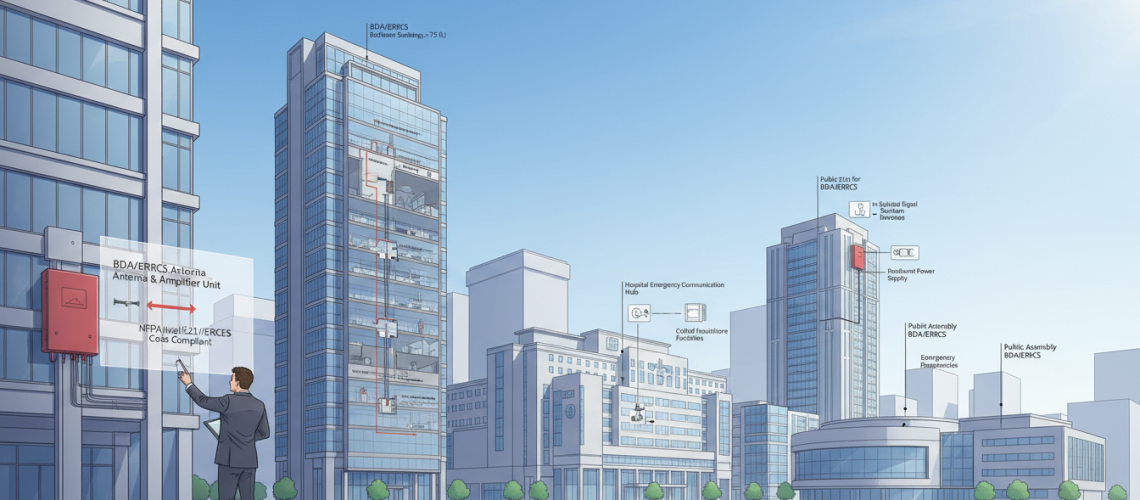
Picture this: you walk into a newly finished downtown structure, and an alarm sounds. Fire teams radio in, but signals fade inside thick walls. That moment shows why public safety signal boosters matter.
You need clear communication in big spaces. New construction over 50,000 square feet and below‑grade areas above 10,000 square feet face strict safety rules. Local authorities can hold your certificate of occupancy if minimum signal strength of -95 dBm in critical areas isn’t met.
The National Fire Protection Association and the International Fire Code set the standards for reliable coverage. Early installation saves money and keeps first responders connected during an emergency.
Key Takeaways
- Identify properties over size thresholds early in design to plan coverage.
- Meet the -95 dBm minimum in critical areas to avoid occupancy delays.
- Follow NFPA and international fire code standards for public safety compliance.
- Install public safety boosters during construction to cut retrofit costs.
- Prioritize radio communication, testing, and proper installation for responder safety.
Understanding the Importance of Public Safety Communication Systems
Clear radio links inside large structures save lives when every second counts. You need reliable radio coverage so first responders can coordinate rescue, control hazards, and keep occupants safe.
Dense materials like concrete, metal, and Low‑E glass weaken signals and break contact between crews inside and command outside. NIOSH recommends every firefighter carry a portable radio and train on its use to reduce risks during fire events.
The public safety world has shifted toward digital bands in the 700 MHz and 800 MHz ranges. That change improves clarity, but indoor signal gaps persist without proper planning and equipment.
Why this matters: reliable responder radio links prevent injuries and save lives. Your responsibility as an owner or manager is to ensure communication systems work when they are needed most.
- Provide proven coverage so emergency responder radio devices stay connected.
- Mitigate weak signal zones created by heavy materials.
- Train staff on radios and test coverage often to meet safety expectations.
Determining What Buildings Require a BDA or ERRCS System by Code
Start by checking whether your property crosses local area thresholds that trigger mandatory signal testing.
Critical Areas and Signal Strength Requirements
New projects with 50,000 square feet or more must meet a minimum -95 dBm in critical zones. Below‑grade spaces over 10,000 square feet also face testing and compliance checks.
Focus on stairwells, elevators, and command centers. These areas need reliable radio coverage so first responders can work safely during an emergency.
The Role of Site Surveys
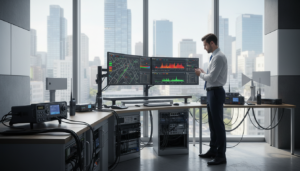
Have an FCC GROL technician run an RF site survey to record signal levels in dBm. Tools like the Anritsu S412E LMR Master test both 700 MHz broadband and P25 narrowband bands.
The AHJ reviews survey heat maps to decide if a public safety enhancement is required. If coverage fails, work with a qualified integrator for design and installation that meets local fire codes.
- Survey early in design to spot dead zones and save retrofit costs.
- Test critical areas to confirm -95 dBm signal strength.
- Submit heat maps to local fire jurisdiction for compliance review.
| Threshold | Test Tool | Responsible Party | Required Result |
|---|---|---|---|
| ≥ 50,000 sq ft (new) | Anritsu S412E LMR Master | FCC GROL technician | -95 dBm in critical areas |
| Below grade ≥ 10,000 sq ft | RF site survey gear | Qualified integrator + AHJ review | Verified radio coverage |
| Failing coverage | Design and install enhancement | Integrators + local fire | Compliance with codes |
Next step: hire professional services for thorough testing, design, and compliance filing so your project meets public safety standards and keeps responders connected.
Navigating National Fire Protection and International Building Standards
Regulators expect demonstrable coverage and reliable backup power for life‑safety communications. You must align design, testing, and installation with national standards so emergency responder radios work when it matters.
NFPA Guidelines for Emergency Communication
NFPA 72 sets tight benchmarks: 99% coverage in critical areas and a 24‑hour battery backup power source for mass notification and radio enhancements.
That standard also calls for regular testing to confirm signal strength and pathway survivability during fire events.
International Fire and Building Code Provisions
The International Fire Code and International Building Code shape jurisdictional rules across the United States.
IFC references UL 2524 for in‑building two‑way radio equipment, while IBC promotes smart technologies to improve public safety. Many states have adopted these editions, so plan for compliance early in design.
FirstNet and Public Safety Broadband
FirstNet uses the 700 MHz band to give first responders a dedicated broadband for mission traffic.
Use FirstNet coverage and traditional radio strategies together to maintain redundancy, backup power, and consistent testing to satisfy local fire and safety authorities.
- Follow NFPA testing schedules to verify signal and strength limits set by your jurisdiction.
- Design backbone pathways to match fire ratings for pathway survivability.
- Confirm UL 2524 compliance when selecting equipment for installation.
Essential Steps for System Design and Compliance Testing
Start your design with clear goals: define target coverage, backup power needs, and who signs off at each milestone.
Selecting the Right Class of Signal Booster
Choose Class A when you need higher power for larger areas and specific channels. Class A suits wide open floor plans that need robust radio coverage.
Choose Class B for smaller footprints under 500,000 square feet. Remember to register the unit with the FCC and secure written consent from the frequency license holder under FCC Part 90.219.
- Keep ERP noise low: FCC rules limit passband noise to -43 dBm in 10 kHz.
- Involve owner, integrator, and AHJ during design, installation, and testing.
- Include reliable backup power so responders keep radio links during outages.
| Choice | Use Case | Key Action |
|---|---|---|
| Class A | Large area, high power | Design for channel-specific coverage |
| Class B | Smaller area & registered | Obtain FCC consent and register |
| Compliance | Public safety review | Submit heat maps and test reports to local fire |
Rigorous testing proves that signal strength meets local standards. Use professional services for installation and plan annual testing to keep your public safety investment in top shape. This process protects responders and preserves your occupancy approval.
Conclusion
Early planning for in‑building radio coverage prevents last‑minute delays and costly retrofits.
You must treat safety as non‑negotiable. Meet signal strength targets, follow the international fire code, and document test results for local review.
Keep testing on schedule and involve qualified techs for installation and verification. Proper design and power backups help first responders stay connected during an emergency.
Invest in quality public safety equipment now to protect occupants and speed compliance. Staying current with standards reduces penalties and keeps operations ready.
Final tip: plan early, test often, and partner with experts to secure reliable radio coverage and lasting safety for everyone.
FAQ
Which types of properties typically need an emergency responder radio enhancement?
Large venues, underground transit stations, high-rise office towers, hospitals, nursing homes, and long-baseline parking garages often fall under local fire and building requirements. Occupancies with dense construction or deep below-grade levels tend to block radio signals, so authorities having jurisdiction like fire marshals often mandate in-building coverage to protect first responders and occupants.
How does signal strength affect public safety communications inside your structure?
Weak indoor coverage can prevent firefighters, police, and EMS from receiving life-saving information. Adequate signal levels let responders transmit clearly to dispatch and other crews. You’ll want at least the minimum receive/transmit thresholds specified by the authority having jurisdiction and referenced standards to ensure reliable two-way radio performance.
Who decides if your property needs an in-building radio enhancement?
The local fire department or building official enforces requirements, guided by model codes and standards. Municipal inspectors reference NFPA 1221, NFPA 72, and the International Fire Code or International Building Code provisions when determining coverage obligations for public safety radio systems.
What role do site surveys play in planning a public safety radio solution?
A site survey maps existing coverage, identifies dead zones, and measures signal levels. It informs antenna placement, amplifier size, and cabling. Without a professional survey you risk undersizing equipment or missing critical areas such as stairwells, mechanical rooms, and elevator shafts.
Which national standards guide the design and testing of emergency responder radio coverage?
NFPA documents—especially NFPA 1221 for communication systems and NFPA 72 for fire alarm and emergency communications—outline design, installation, and testing practices. The International Fire Code and International Building Code include complementary provisions requiring maintained radio coverage for life safety.
Is FirstNet relevant to indoor public safety communications for your facility?
Yes. FirstNet provides a dedicated public safety broadband network that complements traditional land mobile radio. When planning in-building solutions, consider whether responders will use FirstNet devices; that affects antenna types, frequency bands, and system interoperability requirements.
How do you choose the correct class of signal booster or distributed antenna solution?
Selection depends on building size, construction materials, frequency bands in use, and required coverage levels. Options range from passive distributed antenna systems to active repeaters and Class A/B boosters. Your design professional should match equipment to survey data and code-mandated performance metrics.
What testing and maintenance steps ensure ongoing compliance with fire and building rules?
Acceptance testing must demonstrate required signal levels across all critical areas. Documented periodic testing and backup power verification keep systems compliant. Maintain records of tests, repairs, and battery replacements to satisfy inspectors and ensure reliable operation during incidents.
What power and redundancy measures should be included for reliability?
Emergency responder coverage systems usually require backup power—batteries or generator connections—to operate during outages. Redundant paths for signal distribution and monitoring alarms for system faults help ensure continuous service when first responders need it most.
How can you engage your local authority having jurisdiction early in the project?
Contact the fire marshal or building official during design so you can align survey scope, performance targets, and testing protocols with their expectations. Early coordination reduces rework, speeds approvals, and helps you avoid costly retrofits after construction or renovation.